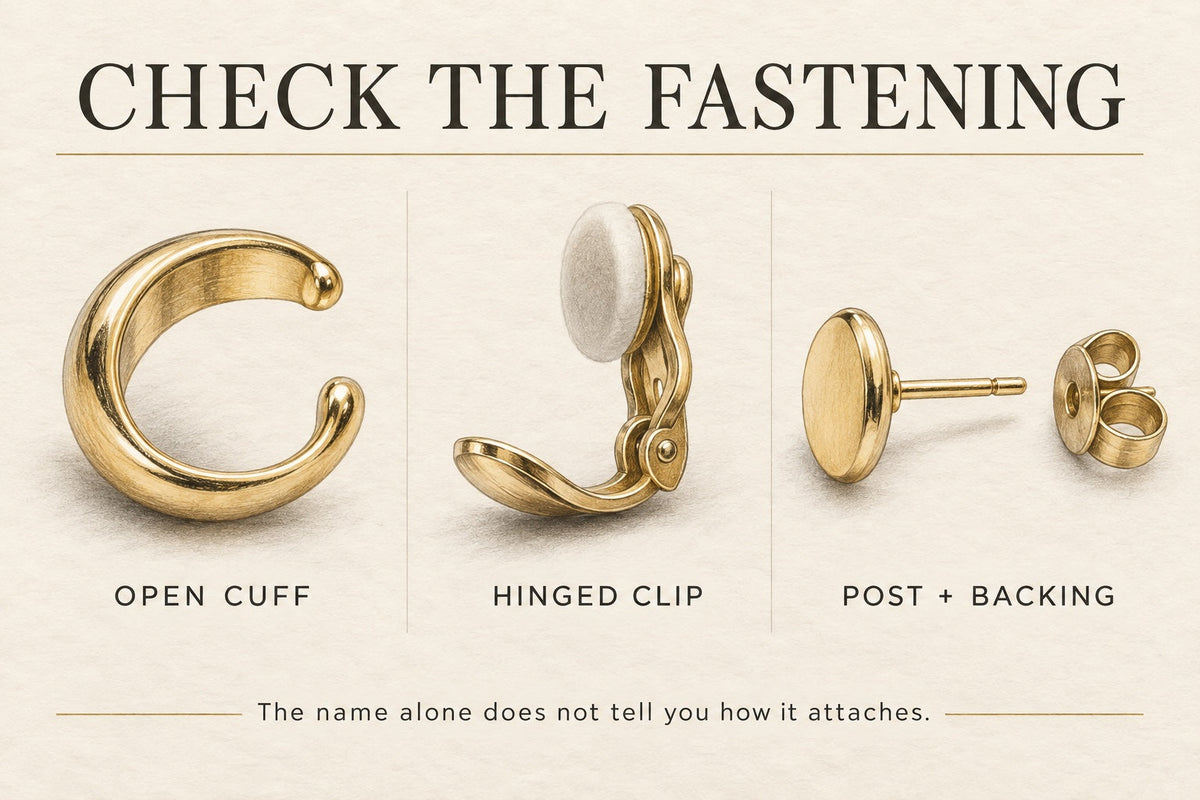
Do ear cuffs need piercings? A simple open cuff that grips the outer ear can be worn without a piercing. A design with a post needs the appropriate piercing. The words “ear cuff,” “ear wrap,” and “ear climber” describe a look, but do not reliably identify the fastening.
Will an ear cuff fall off? It can if the shape, opening, position, or fastening does not suit your ear. A tighter squeeze is not a reliable solution. Choose a compatible design, follow its instructions, and check that it stays comfortably in place before going out.
This buying guide helps you decide what to look for before you order. It also explains the different information available for OsaRosa’s Elven Harp and Crane Pearl designs. For a fuller placement and styling walkthrough after choosing a piece, use our ear cuff wearing guide.
The three AI-generated illustrations explain generic fastening and fit concepts. They are not photographs of OsaRosa products, product-specific fitting diagrams, or a promise of fit.
Do ear cuffs need a piercing? Check the back, not just the name
Look for the actual attachment. A non-pierced cuff has no post that passes through the ear. A hinged clip closes around part of the ear. A post-and-backing design attaches through a piercing. A longer sculptural piece may combine more than one attachment point.
A front photograph is useful for choosing a silhouette, but the rear view and written specifications are often more useful for deciding whether you can wear it. If you can see a post, or the listing mentions one, do not assume the piece is a non-pierced design.
| Type | What to identify | What to confirm |
|---|---|---|
| Open cuff | An opening around the outer ear, with no piercing post | Intended position and whether any adjustment is permitted |
| Hinged clip | A hinged closure rather than a post | Where the clip sits and how it opens and closes |
| Post with backing | A straight post and a separate or attached fastening | Which piercing it uses and which backing is supplied |
| Sculptural wrap or climber | A longer form that follows the ear | Every attachment point, orientation and piercing requirement |
What if a listing mentions both clips and a post?
Ask for clarification before ordering. It may describe multiple attachment points or different variants, but that cannot be established from the wording alone. Request a rear-view photograph and instructions for the exact option you intend to buy. Do not remove, bend, or ignore a post to try to convert a pierced design into a clip-on.
Do ear cuffs fall off? Four things that affect security
A cuff should remain in place without forceful clamping. Ear shape, opening size, intended position, and everyday contact all influence security. There is no honest “never falls off” guarantee that covers every ear and activity.

1. The shape of your ear
The curve and thickness of the outer ear vary from person to person. A position shown on a model is a visual reference, not proof that the same piece will sit identically on you. A longer wrap also needs enough space for its decorative frame and any supporting attachments.
2. The cuff opening or fastening
A loose opening may allow movement, while an overly tight one may feel uncomfortable. For pierced designs, check the correct backing and all intended supports. Adjust only if the maker explicitly permits it; an open appearance does not mean a fixed frame is designed to bend.
3. Placement and balance
A simple pressure-fit cuff and an elaborate wrap distribute their weight differently. Seat the piece in its intended position and handle its main body, not a dangling pearl, crystal, chain, or delicate branch. If it only stays in place when positioned somewhere the design was not intended to sit, ask for advice rather than improvising.
4. Contact with hair, glasses and headphones
Hair, glasses arms, headphones, and clothing can move a piece that initially seemed secure. Try the combinations you actually use at home. If another item presses against the cuff or dislodges it, remove the jewelry or change the combination rather than accepting constant pressure.
Quick fit check: use a mirror, turn your head gently, and check whether the cuff shifts during ordinary movement. Repeated slipping or uncomfortable pressure is a reason to remove it and reassess the fit, not to pinch harder.
How do you wear an ear cuff? Identify the design first

For a simple open, non-pierced cuff: follow its intended entry point and position. For a post-based or multi-point ear wrap: use the instructions for that exact design. The same sequence should not be applied to every ear piece.
- Check the instructions and orientation. Confirm left or right ear, all fastenings, and whether the piece is a single item or a pair. Make sure you understand how it comes off before putting it on.
- Prepare a clear view. Use clean, dry hands and a mirror, move hair away, and work over a soft surface. This makes it easier to inspect attachments and protects a piece if it slips from your hand.
- Position gently. For a confirmed open cuff, many designs slide onto a thinner part of the outer ear and settle into their intended position. Do not force it across a thicker area. For a post-based piece, follow the specified piercing and fastening instructions instead.
- Check every attachment. Inspect the cuff or backing in a mirror. Keep decorative details free of hair. Do not pull a drop or chain to reposition the main frame.
- Test comfort and stability. Check ordinary head movement and any glasses you will wear. If the piece slips, pinches, or needs force to remain in place, take it off and ask about the design.
Some cuffs permit a small initial adjustment; others do not. Maker-specific instructions take priority. For example, Mara Paris’s own care guide cautions against repeatedly opening and closing its cuffs because bending can weaken them. That guidance illustrates why you should not assume a cuff is elastic; it is not an instruction to adjust every OsaRosa piece.
Choose an OsaRosa ear piece: shape first, fastening confirmed
Once you understand the attachment, choose the visual story you want to wear. Both pieces below have sculptural details, but their current listings are not sufficient to advertise them as universally non-pierced.
Elven Harp Ear Cuff: harp-like lines and a crystal drop
The Elven Harp Ear Cuff combines a silver-toned harp frame, botanical details, butterflies, and a suspended teardrop crystal. The listing describes platinum-plated brass and synthetic crystal. It also mentions clip-style attachment instructions and a 925 sterling-silver post.
Before buying: ask which fastening applies to your selected option and whether it requires a piercing. These two descriptions should not be treated as proof of a non-pierced version. Choose the silhouette because you like its lines, then confirm the practical details before ordering.
Crane Pearl Ear Cuff: a bird-inspired silhouette
The Crane Pearl Ear Cuff pairs a gold-toned bird-and-branch form with a pearl drop. Its specification lists gold-plated copper, pearl, and a 925 sterling-silver post. The product handle refers to a single right-ear design; verify the selected option and current orientation information.
Before buying: confirm the required piercing, intended ear, supplied fastening and item quantity. A sterling-silver post does not mean the entire decorative body is solid silver, nor does it guarantee that every wearer will tolerate every component.
Need clarification? Contact OsaRosa or email support@osarosa.com with the product name and selected option. Ask: “Does this exact version require a piercing, which ear is it for, and can you show how the back attaches?”
Buy ear cuffs in the US, Canada or UK: a practical checklist
The fit questions remain the same wherever you shop. For readers ordering in the US, Canada or UK, check the delivery country and currency shown at checkout rather than inferring them from the language of the storefront. USD, CAD and GBP are different currencies.
- Fastening: is it definitely non-pierced, pierced, or still unclear?
- Orientation: left, right, reversible, or a matched pair?
- Quantity: does the listing sell one ear piece or two?
- Materials: what are the post, body and decorative components made from?
- Dimensions: will the piece have room alongside glasses and your usual hairstyle?
- Delivery and returns: have you checked the current terms for your destination?
Review the shipping policy and return policy before ordering, particularly for a fixed event date. Do not assume local dispatch or a guaranteed arrival date based on this guide. If you are buying for someone else, our art-inspired jewelry gift guide can help you choose a meaningful shape without overlooking fit.
Frequently asked questions before choosing an ear cuff
Can I wear an ear cuff without pierced ears?
Yes, if that exact design is made to attach without a piercing. Check for a post and read the fastening description. If the information conflicts, ask before purchasing.
Should an ear cuff feel tight?
It should feel comfortably secure, not forcefully clamped. If it pinches or needs constant readjustment, remove it and check whether the position or design is suitable.
Can I wear a cuff on either ear?
Only if its shape and fastening are intended to work that way. Directional ear wraps should not be forced into a mirrored position.
Can I sleep or exercise in a sculptural ear wrap?
This guide does not recommend those uses. Follow the product’s care instructions and remove delicate pieces when pressure, snagging, moisture, or vigorous movement could affect them.
What should I choose if I cannot confirm the fastening?
Pause the purchase and request clearer information. A precise answer about the selected version is more useful than guessing from a styled photograph.
Choose the design you love—and the attachment you understand
An ear cuff can offer an expressive silhouette without requiring a whole new jewelry wardrobe. The best purchase starts with three clear answers: whether it needs a piercing, how it attaches, and whether its shape suits the way you want to wear it. Browse OsaRosa earrings, use the checks above, and confirm any missing detail before choosing your piece.


