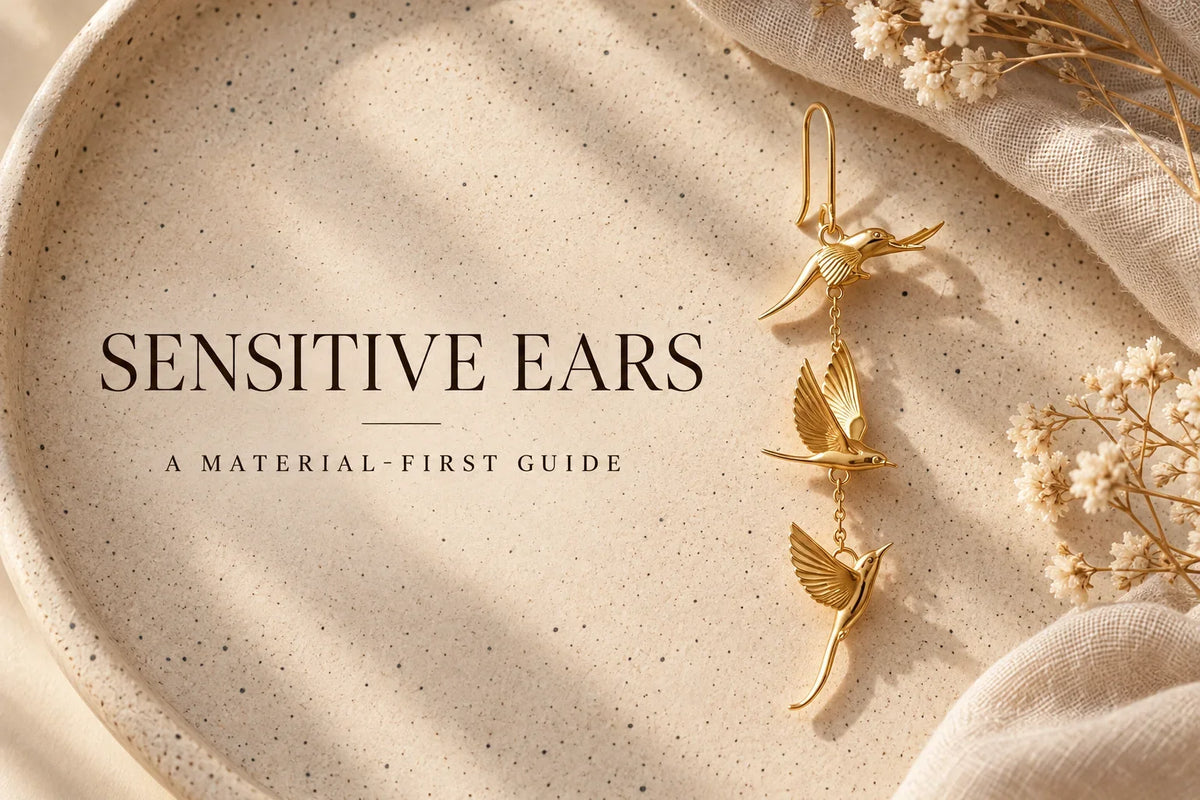
Choosing earrings for sensitive ears starts with the materials—not just a “hypoallergenic” label. Check the post or hook, the back, and any decorative metal that touches your skin.
You spot a pair of earrings you love. Then you remember the last pair: itchy lobes, a red patch, and a jewelry box full of pieces you hesitate to wear. A little information can make shopping less of a guessing game. It cannot guarantee that a particular earring will suit your skin.
This beginner’s guide explains what to ask about metals, how to read OsaRosa’s product descriptions, and why a sterling-silver post is different from an entirely sterling-silver earring. It is a shopping guide, not a diagnosis or a replacement for advice from a dermatologist.
“Hypoallergenic” Is a Starting Point, Not a Promise 👂
The most useful question is not simply, “Is this hypoallergenic?” It is, “What are all the parts that will touch my skin made from?” A broad label does not identify the alloy, the plating underneath, or the material of an earring back. No material is guaranteed to work for every person.
Nickel is one possible cause of allergic contact dermatitis. The American Academy of Dermatology identifies earrings and earring backs among common sources of nickel exposure. That does not mean every uncomfortable earring is causing a nickel allergy; a reaction needs appropriate assessment. Read the AAD’s nickel-allergy guidance.
If you already know which metal you react to, use that information rather than relying on a general label. Ask for the composition of the specific design and variant you want. If the details remain uncertain, choose an option with clearer documentation.
Read the Earring from the Inside Out ✨
1. The post or hook
This is the part passing through the piercing. Look for a named material, rather than only a color such as “silver” or “gold.” A listing that says “925 sterling-silver post” is describing that component—not automatically the decorative body, solder, finish, or back.
2. The back or fastening
An earring back also contacts your skin. Ask about it separately if its material is not listed. A clear description of the post does not fill in missing details about every other part.
3. The decorative body
Large drops, sculptural ear wraps, and cuffs can rest against the lobe, cheek, or outer ear. Their base metal and surface finish matter too. An ear cuff that avoids a piercing can still create metal-to-skin contact.
| Description | What it identifies | What to ask next |
|---|---|---|
| 925 sterling-silver post or hook | The named fastening component is described as sterling silver. | What are the back, body, and any coating made from? |
| Gold-plated brass or copper | A gold surface over a different base metal. | What is the full base-metal and coating specification, including any underlayer? |
| Gold-filled | A bonded gold layer over a core; it is not the same construction as thin gold plating. | What are the alloy, core, and separate fastening components? |
| Solid gold | A gold alloy throughout the named component, with fineness given by its karat. | What alloy metals are included, and does the description cover the whole piece? |
| Gold-tone or silver-tone | A color description. | What is the actual metal? |
A finish is not an allergy certificate. Likewise, a 925 stamp does not document the composition of an entire mixed-material design. If you have a confirmed allergy, discuss suitable materials with your clinician and request product-specific information before buying.
How to Read OsaRosa’s Earrings: Three Examples
These examples show how our listings describe different components. They are not a medically approved selection or a guarantee of suitability for sensitive ears. The details below reflect the product descriptions checked when this guide was prepared; consult the current listing and ask us about anything it does not specify.
Golden Lark Earrings: Check the Hook and the Birds
The Golden Lark Earrings listing identifies 925 sterling-silver hooks and a gold-plated alloy body. Those are separate descriptions. The birds create a long, moving silhouette, while the fastening is the component passing through the piercing.
Before choosing them for sensitive ears, ask about the body alloy, any finish on the hook, and every part that may touch your skin. The listing describes the hooks as nickel-free, but that wording is not an independent test report for the entire earring.

Renaissance Oyster Pearl Earrings: A Silver Post Is Not the Whole Shell
The Renaissance Oyster Pearl Earrings listing specifies a 925 sterling-silver post. Its shell-shaped setting, miniature artwork, and pearl drop create an art-inspired focal point.
The post description alone does not establish the full composition of the shell, back, or decorative parts. If those details matter for a known allergy, contact us before ordering rather than treating the silver-colored setting as proof of solid silver.

Crane Pearl Ear Cuff: Consider the Full Contact Area
The Crane Pearl Ear Cuff listing describes gold-plated copper and a pearl, with a 925 sterling-silver post. Its curved form extends along the ear, so the post is not the only potential contact point.
This is listed as a single right-ear design. Check both the attachment instructions and the materials. An “ear cuff” name is not proof that a design is piercing-free or appropriate for metal-sensitive skin.
Comfort Also Means Paying Attention to Fit and Care
- Do not push through irritation. If a rash appears beneath jewelry, stop wearing it. The AAD recommends avoiding the triggering item; persistent or recurring symptoms deserve professional advice. Read the AAD’s contact-dermatitis guidance.
- Check the fastening. Avoid a back pressed tightly against the lobe or a cuff pinching the ear. Follow the design’s instructions and do not force it into position.
- Follow product-specific care. For the plated designs featured here, keep them away from moisture, perfume, and harsh chemicals; gently wipe with a soft, dry cloth after wear and store them dry.
- Do not confuse cleaning with allergy prevention. A polishing cloth does not change an alloy or make an unknown metal suitable for a diagnosed allergy.
- Ask separately about new piercings. This guide concerns shopping for established piercings, not initial piercing jewelry or healing advice. Follow your qualified piercer’s and clinician’s guidance.
A Five-Question Checklist Before You Buy
- What is the exact post or hook material?
- What is the back or fastening made from?
- Which other components touch my skin?
- What are the base metal, plating, and any underlayer?
- Can the seller provide information relevant to my known allergy?
You can send those questions, together with the product name and variant, to support@osarosa.com. If a detail is not stated, ask rather than assume.
Sensitive-Ear Shopping FAQs
Are all 925 sterling-silver earrings hypoallergenic?
Do not assume that a 925 component guarantees comfort. Check what the description covers, ask about the other components, and use advice appropriate to your own allergy history.
Are gold-plated earrings always unsuitable?
Suitability depends on the complete construction and your sensitivities, not the color alone. Plating may wear and expose underlying material. For a known allergy, request clear specifications rather than assuming the outer gold surface solves the problem.
Are clip-ons or ear cuffs automatically better for sensitive ears?
No. They may avoid a piercing, but their metal can still touch skin and their fastening can apply pressure. Check materials and fit. Our ear-cuff buying guide explains attachment differences.
What if earrings keep making my ears itch?
Stop wearing the suspect jewelry and seek medical advice if symptoms persist or recur. A dermatologist can assess the cause and decide whether patch testing is appropriate. Do not keep wearing a piece to “get used to” a reaction.
Keep the Story. Ask About the Metal. 🤍
Choosing carefully does not mean abandoning expressive jewelry. It means giving the material description the same attention as the design. A bird, a shell, or a sculptural line can still be part of your wardrobe—but the right choice begins with information about your skin and the actual piece.
Explore OsaRosa’s designs, read the individual specifications, and contact us before buying when you need more detail.
More from the Journal
- How to Wear an Ear Cuff: Fit and Styling
- The October Edit: Style Your Myth from Day to Night 🌞🌙✨
- How to Style Sculptural Jewelry
Sources and Editorial Note
Written by OsaRosa as a materials-focused shopping guide. The cover is an AI-created editorial illustration; the product images in the article come from the product listings. General skin-health information draws on the American Academy of Dermatology’s nickel-allergy guidance and contact-dermatitis guidance. This article has not been medically reviewed and does not certify or independently test product materials.


