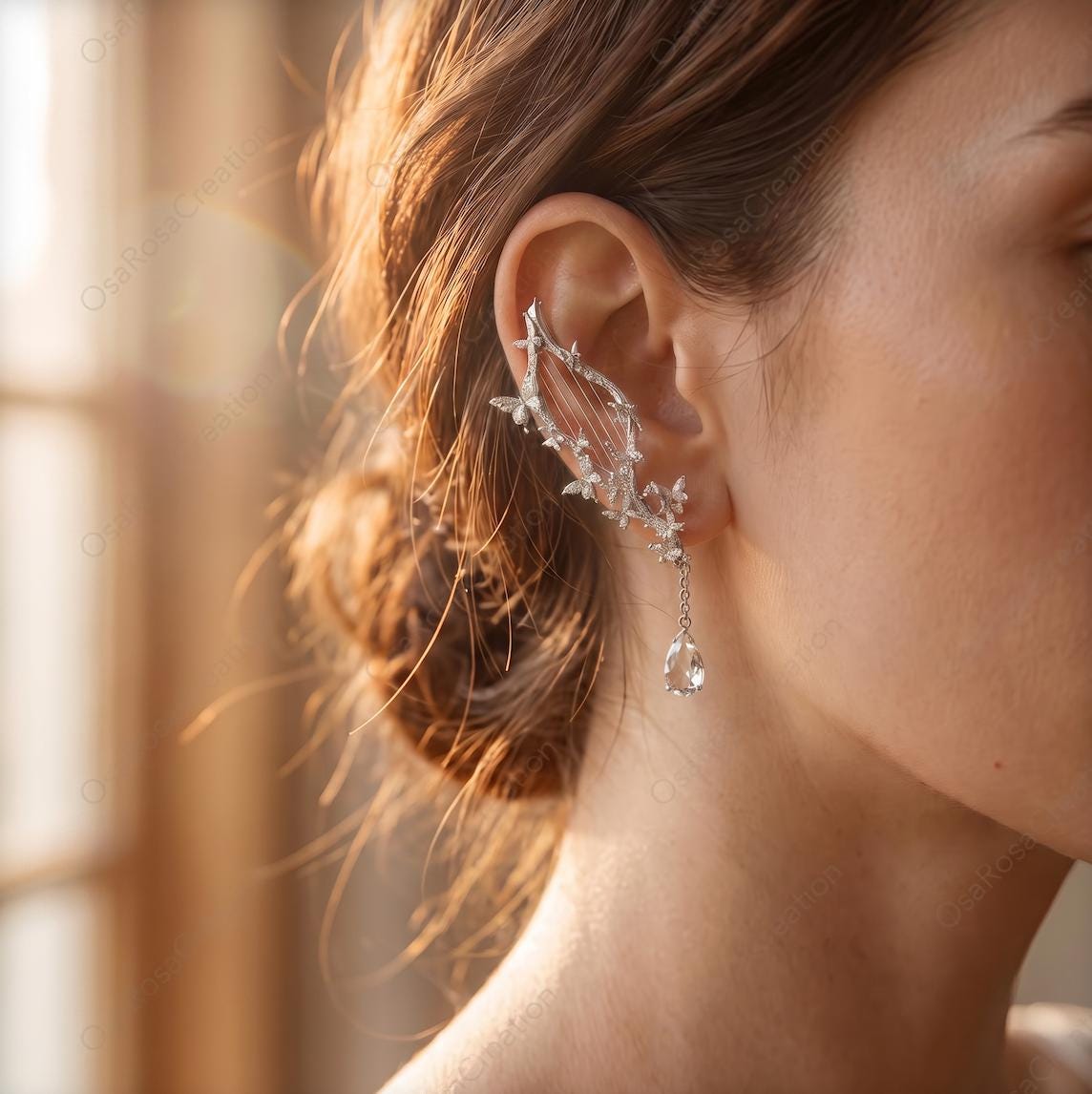
An ear cuff can be a small accent or a sculpture that follows the whole curve of your ear. The right way to wear it depends on its fastening, its shape, and your ear—not simply on the name on the product page. This guide explains how to identify the design, check its fit, and style it without losing the details that made you choose it.
First, check how your ear cuff fastens
“Ear cuff” is used for several kinds of jewelry. A simple open cuff grips the edge of the ear without a post. An ear wrap may follow a longer section of the ear, while a climber can rise from a pierced lobe. Some elaborate pieces combine a post with an upper cuff or support. These are not interchangeable designs.
Before ordering, look at the back of the piece and read the fastening details. Check whether you need a healed lobe piercing, whether the piece is made for the left or right ear, and whether the listing is for a single piece or a pair. A front-facing photograph can show the silhouette beautifully without showing how it attaches.
Do not assume every ear cuff is non-pierced. OsaRosa’s Elven Harp and Crane Pearl product descriptions both mention a sterling-silver post. Elven Harp also describes cuff attachment points. If you need a completely non-pierced option, contact support@osarosa.com with the product name and selected option before purchasing. We can help clarify the fastening rather than asking you to guess.
How to put on a simple pressure-fit ear cuff
The following steps are for an open cuff that is specifically designed to grip the ear without a post. They are not instructions for forcing a fixed ear wrap into a new shape.
- Start with clean, dry hands. Use a mirror and keep hair clear of the area. Work over a soft towel so that a dropped piece does not hit a hard surface.
- Find a comfortable entry point. Many open cuffs can be introduced at a thinner part of the outer ear. Hold the main cuff body rather than a crystal, pearl, chain, or delicate decorative branch.
- Move it gently into place. Guide the opening around the ear’s edge and settle it where its shape sits naturally. Do not force it onto a thicker area.
- Adjust only if the design allows it. Make the smallest adjustment needed. A cuff should feel secure, not tightly clamped. Do not repeatedly bend plated metal, squeeze a stone setting, or change a fixed sculptural frame.
- Check before going out. Turn your head gently and check whether the piece shifts. If it slips or pinches, remove it and reassess the position instead of tightening it aggressively.
Ear shapes vary. A position that looks ideal on a model may not be the most comfortable one for you. If the fit cannot be made comfortable without force, stop wearing the piece and ask for guidance.
Wearing a sculptural ear wrap
A long ear wrap behaves differently from a small cuff. Its design may balance between several contact points, and its decorative structure is part of that balance. Begin by identifying the intended ear and fastening, then support the whole piece as you place it. If it includes a post, use the appropriate healed piercing and fastening; do not treat the post as something to press against unpierced skin.
Elven Harp: a silver-toned statement

The Elven Harp Ear Cuff traces the ear with a harp-like frame, botanical lines, butterflies, and a suspended teardrop crystal. Its listing identifies platinum-plated brass and synthetic crystal, with a sterling-silver post. The silver-toned appearance does not mean that the entire piece is solid silver.
Let the frame sit naturally rather than reshaping the decorative “strings.” Move hair away from the butterfly details and support the main frame when putting it on or taking it off. Check the selected option before ordering: a piece intended for one ear should not be forced into a mirrored position.
Crane Pearl: a warmer, flowing silhouette

The Crane Pearl Ear Cuff combines a golden bird-and-branch silhouette with a pearl drop. Its listing identifies gold-plated copper and a pearl, with a sterling-silver post. Check the right-ear orientation and the current product details before selecting your piece.
Support the body of the wrap, not the pearl drop, when handling it. A dangling detail is there to move freely; it should not be used as a handle or pulled to change the position of the jewelry.
Three ways to style a statement ear cuff
1. Give one piece the lead
A sculptural ear cuff already has a strong outline. Try it with a simple neckline and little competing jewelry around the face. A plain shirt or slip dress gives the harp, birds, and hanging details room to be seen. If you wear another earring, choose a quieter shape rather than another large sculpture.
2. Reveal the silhouette with your hair
A low bun, a tucked-back section, or hair swept to the opposite side can reveal the whole curve. Put the jewelry on after arranging your hair, and check that no strands are caught around the fastening or chain. This also makes the contact points easier to inspect in a mirror.
3. Repeat a detail, not the whole design
For a coordinated look, echo one element elsewhere: a restrained silver-toned ring with Elven Harp, or a small warm-toned pendant with Crane Pearl. Matching every motif can feel busy. Repeating a finish, curve, or pearl detail creates a connection while leaving the ear piece as the focal point.
Explore our earrings for related silhouettes, or read Wear Your Myth for the ideas behind OsaRosa’s approach to wearable symbols.
Care, comfort, and everyday use
For the plated pieces featured here, remove jewelry before showering, swimming, sleeping, or exercising. Keep it away from perfume, hairspray, moisture, and harsh cleaning products. Apply cosmetics before putting on the jewelry, then gently wipe the piece with a soft, dry cloth after wearing it.
Store each piece separately so that a chain cannot tangle around the sculptural frame. Do not use abrasive polish intended for unplated metal without checking whether it is suitable for the finish. A plated brass or copper body should not automatically be cared for as solid sterling silver.
Will an ear cuff stay on all day?
No fit is guaranteed for every ear or activity. Correct fastening and a compatible shape matter more than squeezing harder. Check the piece after changing clothes, using headphones, or moving your hair. Remove it if it feels insecure or uncomfortable.
Can I wear it with glasses or headphones?
Try the combination at home first. Glasses arms and headphone cups can press on the same area as the cuff. If they move the piece or create pressure, choose a different position if the design permits, or remove the jewelry while using them.
Can I adjust any ear cuff?
No. Some open cuffs allow a small adjustment; fixed frames, posts, and delicate settings may not. Never assume that a sculptural ear wrap is bendable because a smaller cuff is. Ask about the exact design before making an adjustment.
Is a sterling-silver post the same as an all-silver earring?
No. The post and decorative body can be made from different materials. The featured pieces list a sterling-silver post alongside a plated brass or copper body. Read the full specification, especially if you avoid particular metals.
Choose the shape, then confirm the fit
The best starting point is a silhouette you love and a fastening you understand. Choose between the harp-like lines of Elven Harp and the bird-and-pearl movement of Crane Pearl, then check orientation, materials, and attachment details before ordering.
Questions about a particular piece? Contact OsaRosa with its name and the option you are considering. A little clarity before purchase helps you choose a piece for the way you actually want to wear it.


