You put on two necklaces, straighten both pendants, and leave the house. By lunchtime, the chains have become one twisted strand. The answer is not always another necklace—or an accessory advertised as an instant fix.
To reduce layered-necklace tangling, start with two pieces that sit at visibly different heights, check how they move with your actual outfit, and store them separately afterward. A separator may help some combinations, but no arrangement is guaranteed to stay tangle-free. If two favorite pieces repeatedly catch, wearing them on different days can be the better styling choice.

First, identify what is actually tangling
Take the necklaces off and lay them separately on a soft surface. Are their chains wrapping around each other, are the pendants catching, or have the clasps simply rotated toward the front? These are different problems. Buying a longer chain will not necessarily fix a projecting charm that hooks into another necklace.
In a Reddit discussion about layered necklaces, wearers reported mixed experiences with cross-connecting clasps. Some liked the result; others described uneven movement and discomfort. That is a reason to evaluate your own combination, rather than treat a social-media trick as a universal solution.
Start with two distinct heights, not three similar chains
Put on your preferred pendant first, then add a simpler chain that sits clearly above it. Look in a mirror while standing naturally. The shorter chain should not rest against the pendant or repeatedly pass through its open details when you move.
There is no single spacing measurement that works on every neckline. Neck shape, the pendant's dimensions, chain length and the garment underneath all affect where a necklace settles. A difference that looks generous on a flat-lay photograph may disappear when worn.
- Compare the necklaces on the exact top you intend to wear.
- Check both the front and the clasps at the back.
- Keep a third necklace out of the test until the first pair works comfortably.
- If you use an extender, confirm that its fittings and material suit the chain.
Let one detailed pendant be the focal point
Two intricate pendants competing at the same height can make a stack feel crowded even before anything tangles. Try one expressive design with one plain chain, or let the pendant stand alone. The aim is to give the shape room to be seen.
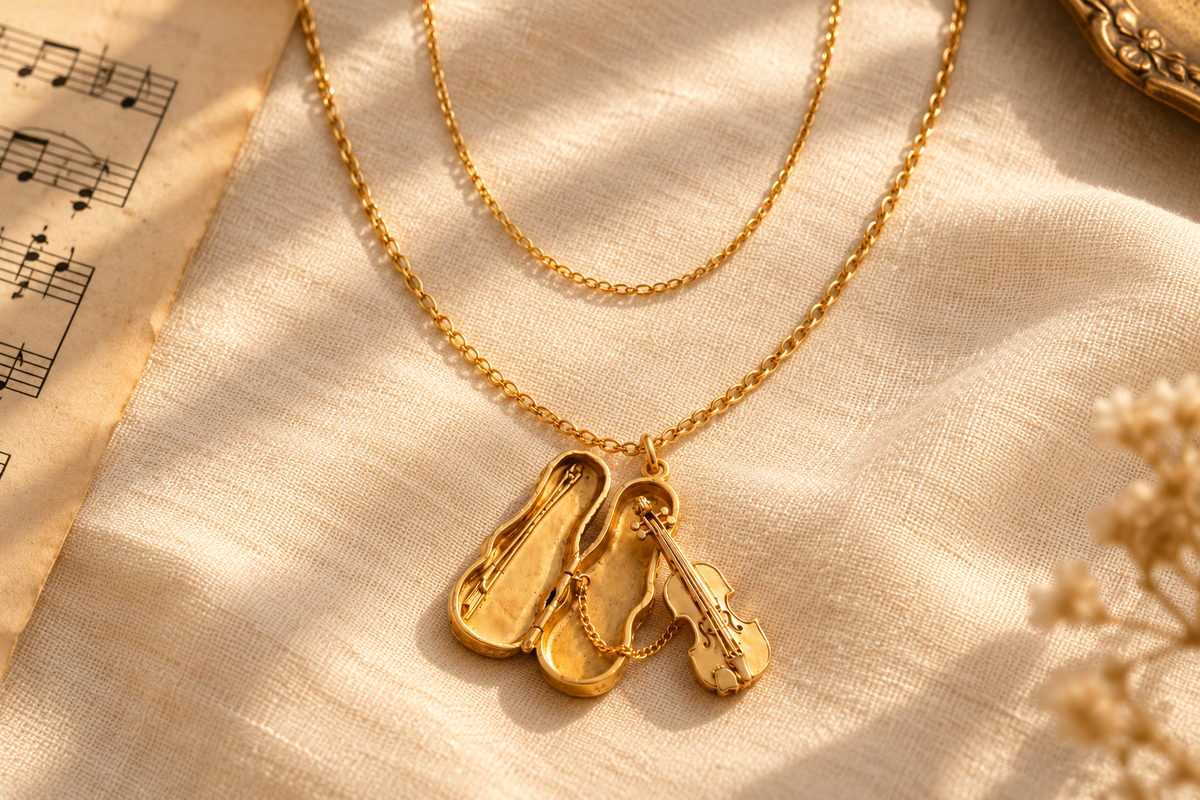
The OsaRosa Violin Pendant Necklace is an example of a detailed, music-inspired focal piece. Its instrument motif offers plenty to look at without requiring several other charms beside it. Use the current listing to review the available finish and photographs; confirm chain length and pendant dimensions before planning a stack around it.

For a concert or gallery visit, try the violin design with a simple blouse and small earrings. If an existing plain chain sits comfortably above it without touching, that can become the second layer. If not, the single pendant still makes a complete outfit. We have not tested this necklace as an anti-tangle design, and this styling suggestion is not a performance claim.
For the separate question of where your pendant should sit against clothing, see our guide to choosing a pendant necklace for a V-neck.
Do a normal-movement check before leaving
Wear the proposed pair at home while sitting, turning your head and reaching for everyday objects. Check whether the pendants touch, a clasp migrates forward, or one chain starts winding around the other. Keep the movements gentle; this is an observation, not a stress test.
If the necklaces interact immediately, change one variable: remove the second pendant, adjust a compatible extender, or return to one necklace. Do not pull the chains apart while they are on your neck. Take them off first if a knot forms.
What about necklace separators?
A separator keeps attachment points apart, but the chains can still move along their length. Before choosing one, check compatibility with the existing clasps, the extra length it adds, and whether it sits comfortably against your neck and hair. It is an optional tool, not a requirement for layered jewelry.
We would not start by linking two independently weighted necklaces into one continuous loop. That changes how the pieces hang and may let one side tighten as the other moves. A simple, independently fastened pair is easier to assess.

Separate the layers when you take them off
Place each necklace in its own compartment or pouch instead of dropping the whole stack into one pocket. Arrange chains loosely rather than pulling them taut, and keep projecting pendants apart. A jewelry roll is useful only if the pieces remain separated when it closes.
Before putting a necklace away, inspect it under good light. If a chain resists gentle separation or a clasp looks bent, stop pulling and ask a jeweler for help. Avoid improvised oils or powders when you do not know how the finish and other materials will react.
Quick questions about tangled necklace layers
Will different chain lengths stop all tangling?
No. Distinct heights are a sensible starting point, but necklaces still move. Judge the actual pairing while worn, not just its listed lengths.
Does a heavier pendant keep a stack in place?
Do not assume so. Weight changes how a necklace hangs, but adding weight is not a verified cure for twisting and may make a combination less comfortable.
Can I wear a statement pendant without layering?
Absolutely. One sculptural pendant can provide the entire focal point. Choose the combination you enjoy wearing, rather than the one that needs constant adjustment.
A simpler stack, a clearer story
Start with a piece you love, give it breathing room, and add a second layer only when it earns its place. Explore the Violin Pendant Necklace and check its current options before building your combination.
Prefer shopping on Etsy? Visit our official OsaRosaCreation Etsy shop and search for the design. Check the current listing, options and availability before ordering.


