A cuff looks beautiful in a close-up, but that photograph cannot tell you whether it will slide around your wrist or feel too tight. An open back can make a bracelet look adjustable without explaining how much adjustment the maker intends.
To choose a cuff bracelet fit, compare your wrist measurement with the bracelet’s inner dimensions and opening, then ask how the specific design is meant to be put on. Do not treat a decorative cuff as something to reshape until it fits.

The real question: loose, or the wrong shape?
In a Reddit discussion about bending cuff bracelets, a shopper with a small wrist asks about a cuff that slides around. The question captures a useful distinction: a bracelet can be wearable without sitting where its owner wants it to sit. Community replies are individual experiences, not instructions for every metal or construction.
Before shopping for a replacement, notice what bothers you. Does the ornament rotate away from the top of your wrist? Does the whole bracelet travel toward your hand? Or does it press at one point while leaving space elsewhere? Those observations help a seller answer more precisely than “Will this fit a small wrist?”
Measure your wrist, not a photograph
Use a flexible tape around the place where you want the bracelet to rest. Keep the tape comfortably against the skin rather than pulling it tight. Record the measurement and its unit. If you use a strip of paper instead, mark the overlap and measure the strip flat afterward.
That number is a starting point, not a complete cuff size. A rigid oval and a round bracelet can feel different even when their nominal measurements sound similar. The width of a broad cuff also changes how much of your wrist it occupies. Compare the inner shape and width with a comfortable bracelet you already own whenever possible.

Four details to request before ordering
| Ask for | Why it matters |
|---|---|
| Inner width and depth | These describe the space available inside the cuff. |
| Opening width | The gap is separate from the inner dimensions. |
| Band width | A broad design occupies more space along the arm. |
| Intended fitting method | An open design is not automatically designed for repeated bending. |
If the listing gives a circumference, ask whether that measurement includes the open gap. Sellers may describe cuff measurements differently, so two numbers are only useful when they were measured the same way. A photo beside a ruler can help clarify dimensions, but it still does not establish how the shape will feel on you.
You can send a concise message: “My wrist measures this amount at the intended wearing position. What are the inner width, inner depth and opening of this cuff, and is adjustment intended?” Include whether you prefer a stationary or more relaxed feel, without asking the seller to guarantee fit from a single measurement.
An openwork example: the Egyptian Cuff
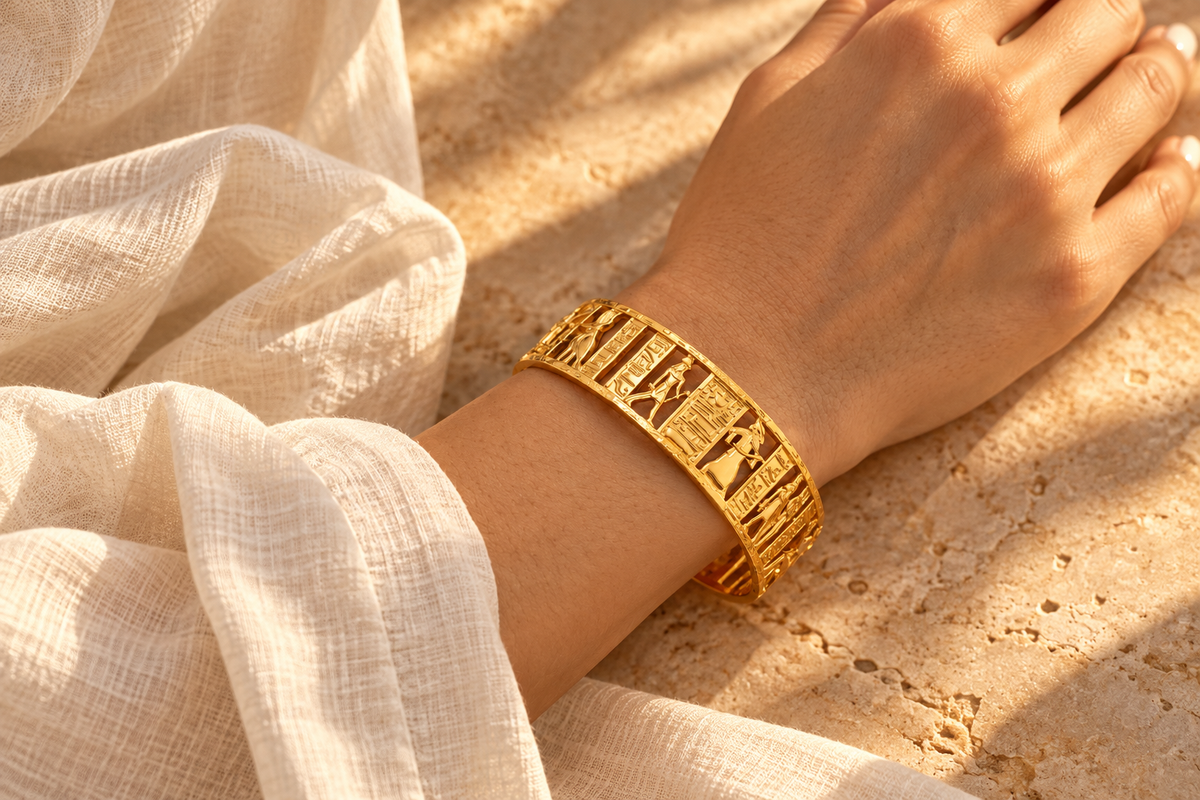
The OsaRosa Ancient Egyptian Openwork Cuff Bracelet features gold-tone figures and hieroglyph-inspired panels framed within a sculptural band. The current description lists gold-plated brass and describes it as gently adjustable.
The details reviewed for this article do not provide a numeric inner circumference, gap width or wrist-size range. “Gently adjustable” should therefore prompt a product-specific question, not an assumption that the cuff fits everyone. Ask which part, if any, is intended to move and how the maker recommends fitting it. The editorial image illustrates styling, not a tested size range.

Try it on without making permanent changes
Read the seller’s fitting and return guidance before a first try-on. Follow the intended entry method rather than pushing the cuff over the widest part of your hand by force. If it resists, stop and ask for guidance. Avoid pliers, makeshift shaping tools or repeated opening and closing to solve an uncertain fit.
Once it is on comfortably, make ordinary small movements over a soft surface. Notice whether it meets your hand, catches your sleeve or rotates more than you like. A little movement may suit one wearer and annoy another; there is no universal finger-gap rule that proves every cuff fits correctly.
For a detailed cuff, a simple sleeve can leave the openwork visible. Our sculptural jewelry styling guide explores that visual balance. When the cuff is off, keep its raised details away from loose chains; our packing guide covers separating decorative pieces.
Frequently asked questions
Does open cuff mean one size fits all?
No. The opening, inner shape and intended adjustment still matter. Ask for measurements rather than relying on the words “open” or “adjustable.”
Should I squeeze a loose cuff tighter?
Only follow the maker’s instructions for that exact design. If the intended adjustment is unclear, contact the seller before changing its shape.
Can a broad cuff work on a small wrist?
Possibly, but decorative width does not establish the inner fit. Check both measurements and compare the visual proportion separately.
Find your own story
Explore the linked OsaRosa product for current details and availability. Prefer Etsy? Visit our official OsaRosaCreation Etsy shop for our designs and check the corresponding listing. Availability, prices and offers can differ between shops.


