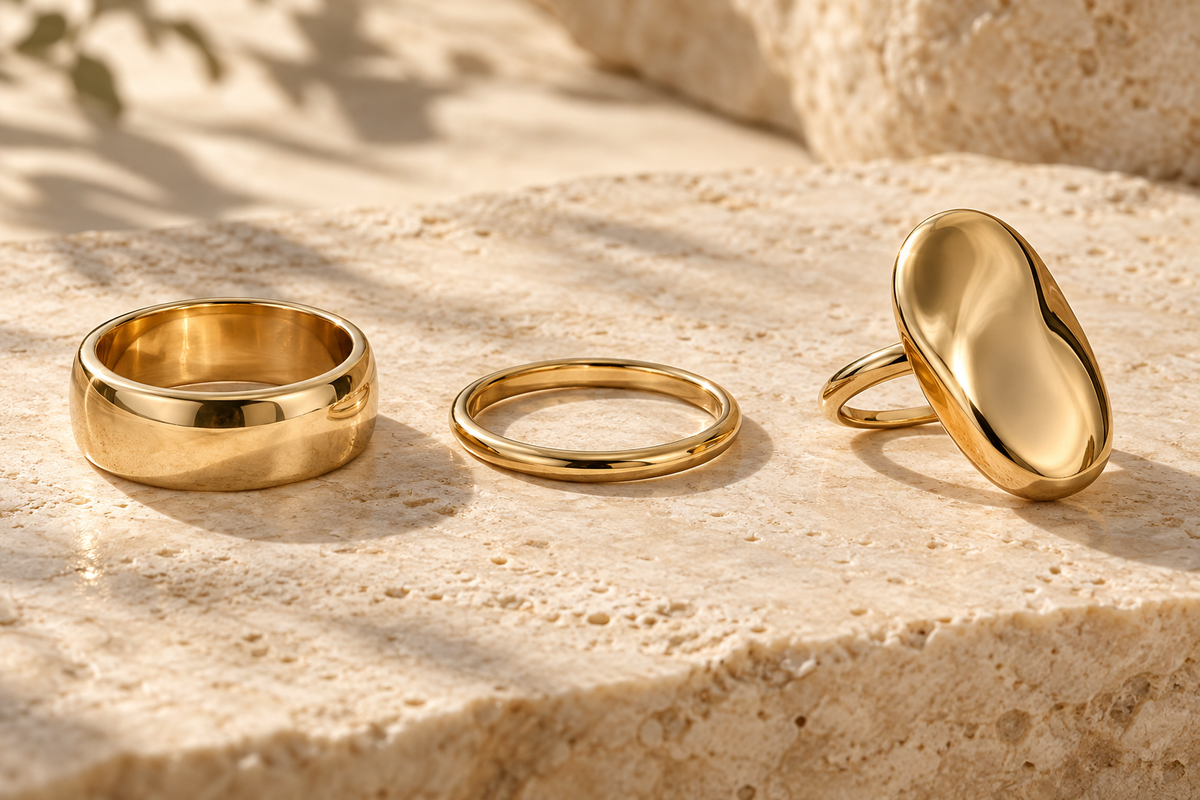
Two rings can look equally dramatic and feel very different on the hand. One makes its statement through a broad band. Another carries a sculptural animal on a much narrower section of metal. Comparing only the front photograph can hide that difference.
To compare wide band vs thin band rings, separate three features: the width of the band around your finger, the size of the decorative top and the height of that decoration above your hand. They influence the look and the wearing experience in different ways.

1. Band width is not the same as statement size
A wide band covers more of the finger along its length. A narrow band covers less, but it may support a large decorative top. A wrap ring adds another variable: its shape may extend along the finger even where individual sections are slim.
Look at side views and wearing photographs as well as the main product image. Ask: where does the metal meet the finger? How close does the design sit to a joint? Does the ornament extend toward adjacent fingers? These questions are more useful than treating every bold ring as a wide band.
2. Choose the kind of statement you enjoy

Temple Colonnade Ring
The Temple Colonnade Ring is an architectural starting point for a substantial band look. Its column-inspired design suits an outfit built around structure: a tailored sleeve, a clean cuff and limited competing detail.
Explore Temple Colonnade Ring →
Lop Bunny Ring
The Lop Bunny Ring offers a different route: a recognizable animal subject. Use the product’s side and wearing views to assess the band and decorative area separately rather than assuming an animal ring must be small or delicate.
Explore Lop Bunny Ring →
Mythic Dragon Ring
The Mythic Dragon Ring illustrates why wrap designs deserve their own consideration. The dragon’s body, head and tail create an extended sculptural outline; it is not equivalent to a plain narrow band simply because parts of the metal are slender.
Explore Mythic Dragon Ring →3. Compare fit with a similar design
Band width can affect how a ring feels, so do not treat a comfortable size in one narrow ring as a guarantee for every wider design. If possible, have your finger measured using a band similar in width to the ring you are considering. Check the seller’s sizing guidance for the specific piece.
A general instruction to “always go up half a size” can be misleading. The inside profile, finger shape and design also matter. QVC’s ring-fitting guide notes that wide bands and narrow bands can fit differently. Use that as a reason to check, not as a substitute for a product-specific fit recommendation.
An open band is not a promise of unlimited adjustment. Follow the individual product guidance and ask about the intended range if it is not stated. Repeatedly bending a piece to experiment with different fingers is not a sizing method.

4. Match the ring to the way you use your hands
Consider when you intend to wear it. A tall ornament may meet a glove or pocket lining. A wide band may feel different when you bend your finger. A slim band with a large top may still occupy plenty of space between neighboring fingers. None of these features automatically makes a ring unsuitable; they tell you what to check.
- Bend and straighten your finger naturally.
- Rest your hand flat and check whether the design presses into adjacent fingers.
- Try the ring with the sleeve or cuff you intend to wear.
- Follow the product’s care instructions for activities and storage.
5. Give one sculptural ring some breathing room
Start with a single statement ring and an uncluttered wrist. This makes it easier to judge its proportions before adding more jewelry. If you introduce a second ring, compare the space between the designs when your hand moves, not only when your fingers are spread for a photograph.
A structured architectural ring and a flowing animal wrap tell different visual stories. Choose the one you want to emphasize rather than trying to make every piece equally noticeable.
Frequently asked questions
Are thin band rings always more comfortable?
No. Comfort depends on the entire design and fit, including the decorative top, inside profile and how the ring meets neighboring fingers.
Do wide rings need a different size?
They may. Compare the specific product’s sizing guidance and, where possible, try a similarly wide sizing band rather than applying a universal size increase.
Is a sculptural wrap ring a thin band ring?
Not necessarily in the way it wears. Slender sections can form a design that covers a large area of the finger. Consider its overall footprint as well as each section’s width.
Choose your silhouette, then confirm the fit. Compare the OsaRosa product photographs above and check the current specifications before deciding.


